The new Canadian Port of Entry employs soothing design elements and a natural aesthetic, enhancing the border crossing experience for travelers and staff alike.
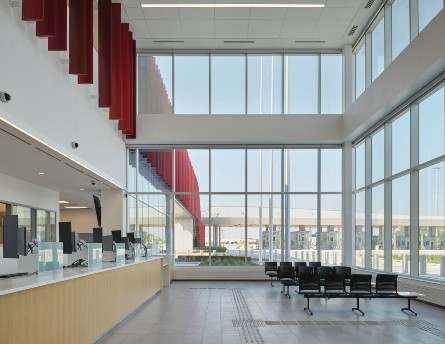
The recently unveiled Canadian Port of Entry serves as both an infrastructural milestone and a testament to thoughtful design aimed at reducing the stress associated with international travel. Located between Windsor, Ontario, and Detroit, Michigan, this expansive facility stretches across 53 hectares and represents a $6.4 billion investment in improving cross-border connections. It features ten buildings, 24 inspection lanes, and 16 toll lanes, thoughtfully interconnected by the newly constructed Gordie Howe International Bridge, the longest cable-stayed bridge in North America.
Moriyama Teshima Architects (MTA) championed a design philosophy that prioritizes calming environments and an intuitive user experience. “Crossing an international border can be inherently stressful, so our approach was to reduce that stress wherever possible,” explains Architect Brian Rudy, emphasizing that the campus was designed to welcome visitors while mirroring Canada's natural beauty. The architecture not only enhances the Travel experience but also signifies the friendly ethos Canada is renowned for.
Designing Calming Experiences
The design team strategically structured the space to make both vehicular and pedestrian movement clear. The primary inspection canopy, for instance, features an upward curve, creating a welcoming entrance that mimics the gentle arc of the Gordie Howe Bridge. This thoughtful design assists travelers in navigating the facility with ease and comfort.
For closer inspections, a secondary canopy was crafted with a playful character, resembling an open hockey net. Covered in translucent polycarbonate, it floods the space with natural light, transforming what could be an intimidating environment into a bright, inviting one. Such attention to detail reflects the commitment to stress-reducing design not only for travelers but also for the staff working on-site.
Staff areas are oriented to provide calming views of Black Oak Heritage Park, with circulation routes that foster intuitive movement patterns. The central observation area, raised for clear sightlines, enhances staff connectivity, reinforcing a sense of security. "When staff feel supported, it directly impacts traveler comfort," Rudy adds, highlighting the symbiotic relationship between staff well-being and user experience.
The circulation spine leads to the staff areas in the main building. Photo by Riley Snelling.
Upon arriving, staff ascend through a visually appealing circulation spine that connects seamlessly to the main buildings. The design evokes seasonal changes, with sunshades reflecting autumnal hues that echo the rich tapestry of the surrounding forest, establishing a deep connection to nature right from the onset of their workday.
Commitment to Sustainability
Sustainability was another cornerstone of the project, which proudly received the Envision Platinum Award from the Institute for Sustainable Infrastructure for exceptional civic design. The Canadian Port of Entry also stands as a LEED v4 Silver certified facility, embedding eco-friendly practices within its operational framework.
This state-of-the-art campus boasts advanced envelope systems, double-pane insulated glass, and energy-reducing technologies, including high-efficiency boiler and chiller plants and air-side heat recovery systems. Such strategies not only bolster operational efficiency but also signify a forward-thinking approach to infrastructure.
Balancing the demands of a significant public-private partnership with architectural integrity posed challenges throughout the development process. MTA navigated these complexities with diligence, ensuring that the design remained coherent and aligned with stakeholders’ varied needs. Since initiating the cross-border traffic study in 2000 to the project's completion this past summer, the collaborative efforts have been remarkable, showcasing a commitment to quality and inclusiveness.
During the ribbon-cutting ceremony alongside the Detroit River, Caldwell First Nation Chief Nikki Van Orskott eloquently remarked on the importance of this connection. Her words served as a reminder of the enduring links that have existed long before modern infrastructure, anchoring the project not just in commerce, but in cultural and community significance.
“These waters carried our ancestors, our stories, our trade, and our relationships,” she stated, emphasizing that the bridge is more than just a functional crossing; it is a pathway toward friendship and cooperation between the nations it unites.
Through its strategic design and commitment to natural harmony, the Canadian Port of Entry sets a new benchmark for border facilities, enhancing the overall travel experience while honoring the rich narratives of the land it occupies.
Discussion
Sign in to join the discussion.