Hunger Games prequel Sunrise on the Reaping uses 1970s style, Warhol-era glamour and Studio 54 flair, to show the Capitol's wealth and menace.
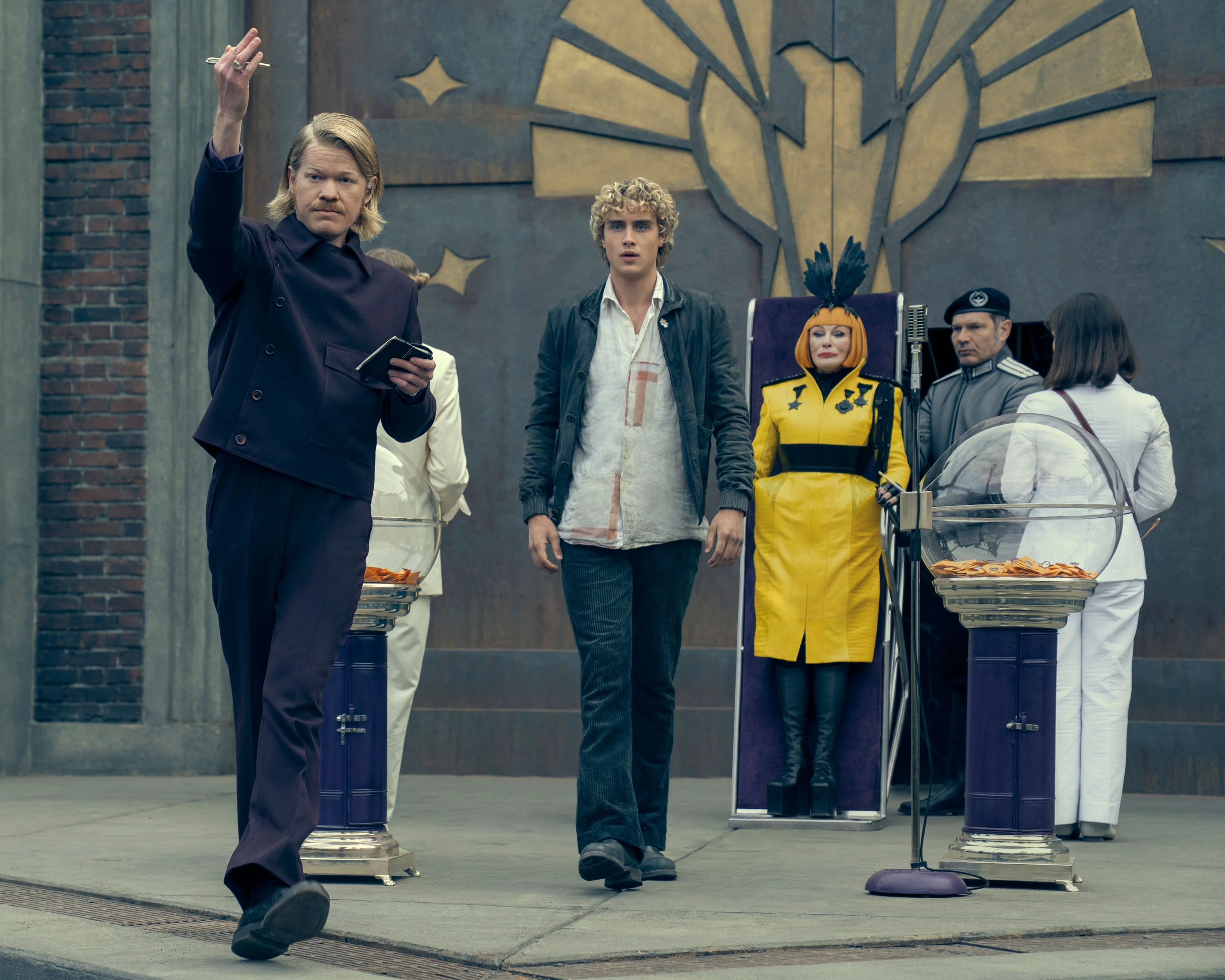
Every new Hunger Games film starts in a conference room at Scholastic in New York. That's where director Francis Lawrence and author Suzanne Collins work through the book together. "I go to New York each time, and we sit in a conference room at Scholastic," Lawrence says. "We go through the book page by page and beat out what we think the movie is going to look like." Lawrence has directed five of the franchise's six films, so that process has shaped most of how Panem looks on screen.
The latest result, The Hunger Games: Sunrise on the Reaping, opens in theaters today. It returns to a postapocalyptic nation where the Capitol keeps twelve districts under brutal control. The central cruelty is the Games themselves: children are chosen by lottery and forced to fight to the death in an arena.
The prequel is set twenty-four years before the 2012 original and follows sixteen-year-old Haymitch Abernathy (Joseph Zada) from District 12. Haymitch later becomes the mentor (Woody Harrelson) to Katniss Everdeen (Jennifer Lawrence) and Peeta Mellark (Josh Hutcherson). This time he's selected for the Second Quarter Quell, a especially sadistic version of the Games that comes around every twenty-five years.
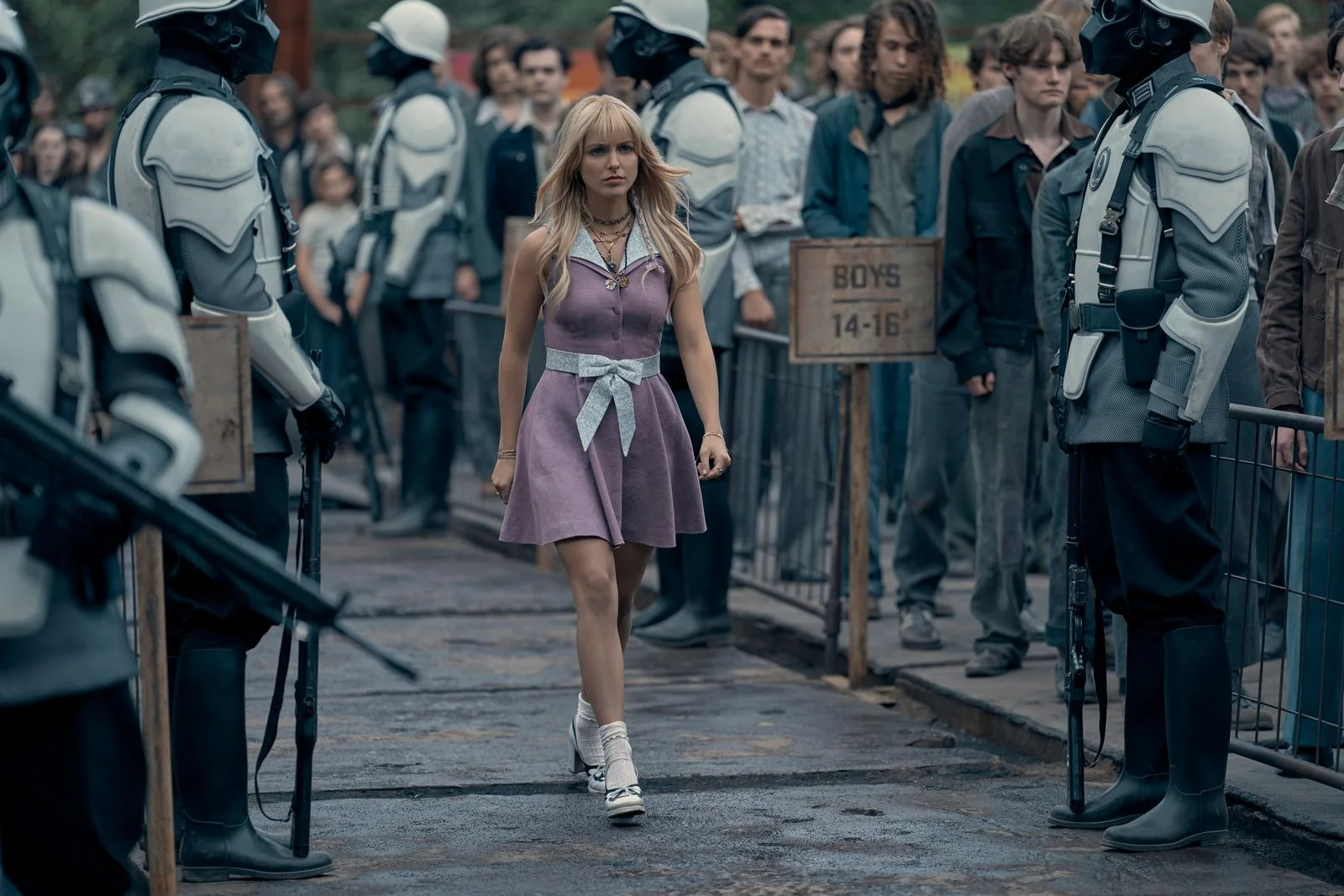
The franchise's dystopia is supposed to be set in a future North America, yet its European influences keep showing. The previous prequel, The Ballad of Songbirds & Snakes (2023), borrowed from the postwar architecture of 1940s and '50s Berlin to show young President Snow climbing toward tyranny.
Sunrise jumps forward forty years and finds Panem at a different stage. Production designer Uli Hanisch, returning from the previous film, traces Haymitch's journey from a poor mining district that barely changes across the series's sixty-five-year timeline to a Capitol drenched in extravagance. That extravagance comes through a 1970s visual language, and that's the choice that defines the film.
"I realized the '70s fall right smack in the middle between that movie and the originals, so we could lean into that," Lawrence says. It's a neat bit of continuity planning, though it's also a bit of a tidy story. The decade sits neatly between the two prequels, and the designers used that position to their advantage.
Hanisch and his team pulled in references to Andy Warhol, Studio 54, and the psychedelic color palette of the period. They borrowed the decade's progressive energy to signal the Capitol's wealth and authoritarianism. In the arena, they go further and turn the look into a weapon of deception. "To turn the '70s style from something progressive, liberal, young, and open-minded into something evil is a twist," Hanisch says. "But that is the key to the entire film's design."

The decade also connects to the books' origins. The 1970s saw color televisions become standard in American homes, and that's when sports spectacles, variety shows, and beauty pageants took off. Those shows set the template for the reality programming Collins later skewers in The Hunger Games. Her own origin story is blunt. "I was flipping through the channels one night between reality television programs and actual footage of the Iraq War, when the idea came to me," she recalled in a 2018 interview with The New York Times. That collision led her to explore just-war theory for young readers, using an authoritarian dystopia where mass entertainment is a tool of political control.
Here's the thing: the film's look isn't just decorative. Its locations pull from politically loaded German sites, including an abandoned rural steel mill and the authoritarian monuments of postwar Berlin. Together they capture Panem at a pivotal moment, both politically and architecturally.
District 12
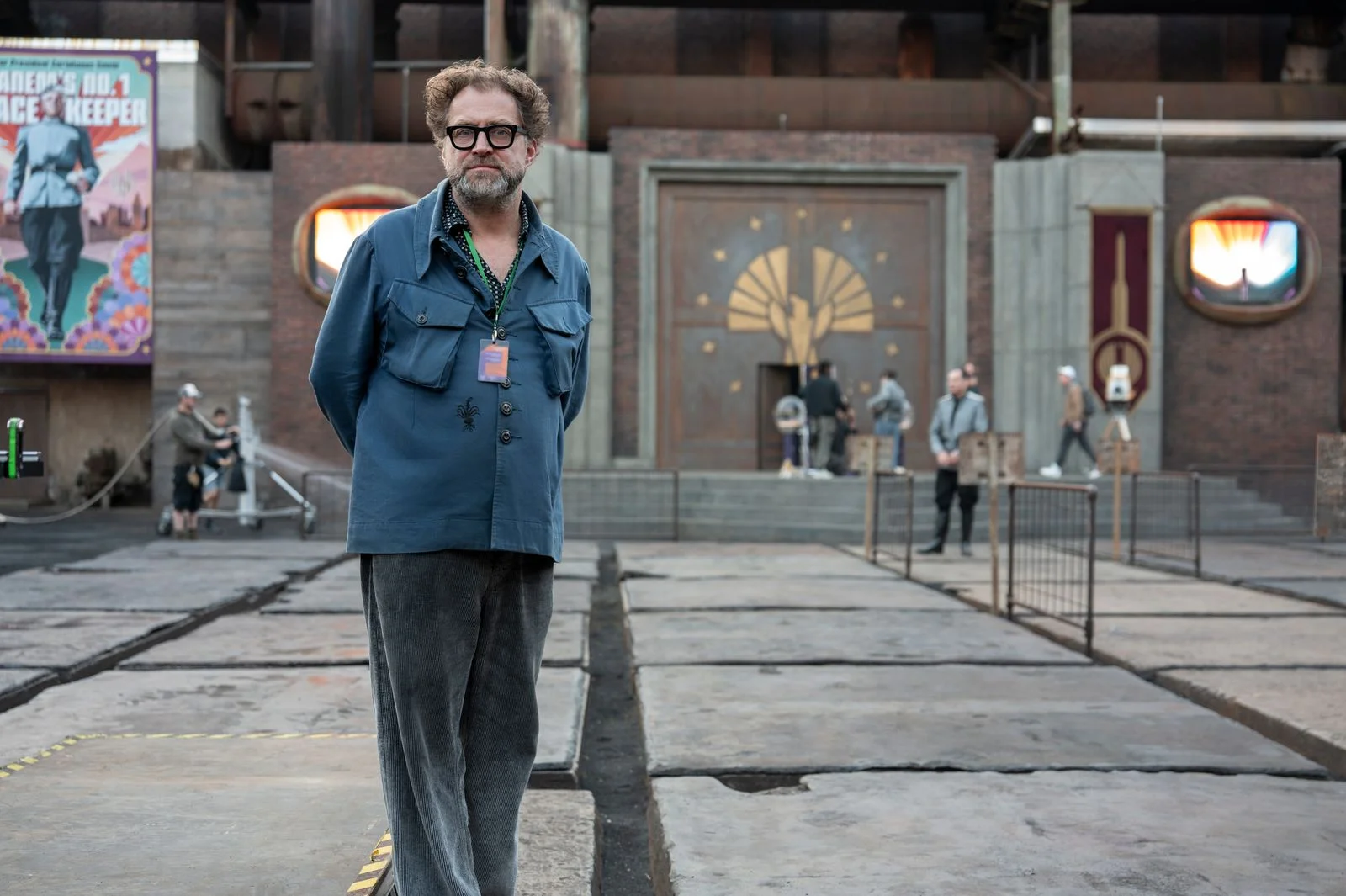
The original films shot District 12 near Atlanta. Its Appalachian-inspired industrial decay was meant to feel worn down and hopeless. For the prequel, the production went to an enormous abandoned steel mill in Duisburg, Germany, which happens to be Hanisch's hometown. Lawrence didn't hide his enthusiasm. "I wish we had it in the original movies, because it is an unbelievable space," he says of the post-industrial, rural terrain. The mill also appeared in The Ballad of Songbirds & Snakes, Hanisch's first film in the franchise. "Everywhere you look is exactly how I have always imagined District 12."
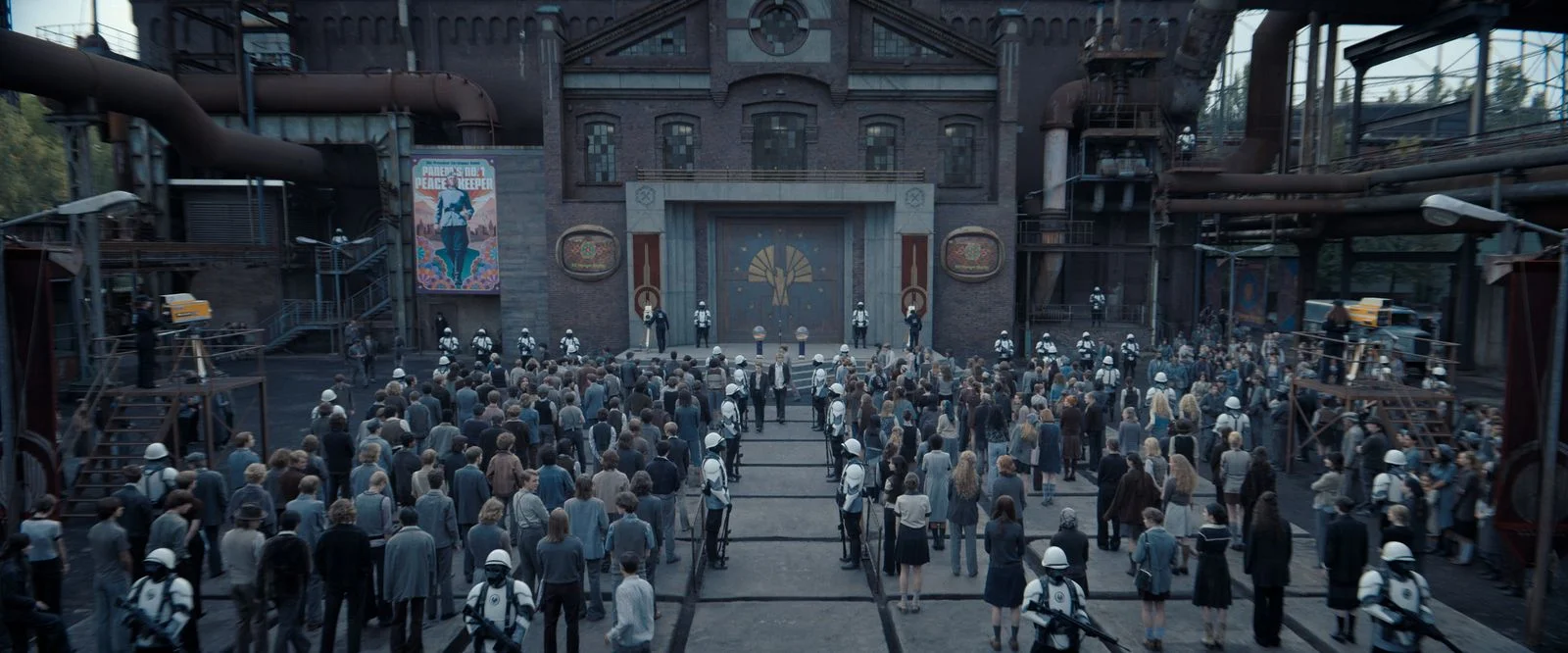
The mill's real-world grit gets translated into the Seam, Haymitch's home turf. The crew built modest huts on the edge of a nearby quarry, and the shacks hold Haymitch, his girlfriend Lenore Dove (Whitney Peak), and fellow tribute Louella McCoy (Molly McCann). Across town, the merchant district where Maysilee Donner (McKenna Grace) lives looks noticeably more prosperous. The contrast is intentional, and it's easy to miss on a first watch.
Hanisch's approach to District 12 is almost the opposite of his Capitol work. "Unlike the Capitol, District 12 doesn't evolve stylistically throughout the films. Nobody is investing in it, and everything is gradually deteriorating," he explains. The Capitol's vivid purples and oranges are missing from the district itself. They show up only in propaganda around the reaping square, including Hunger Games campaign materials and posters that cast Snow as Panem's number-one Peacekeeper. So the bright colors arrive as a message from the Capitol, not as anything the people of District 12 own.
The Capitol
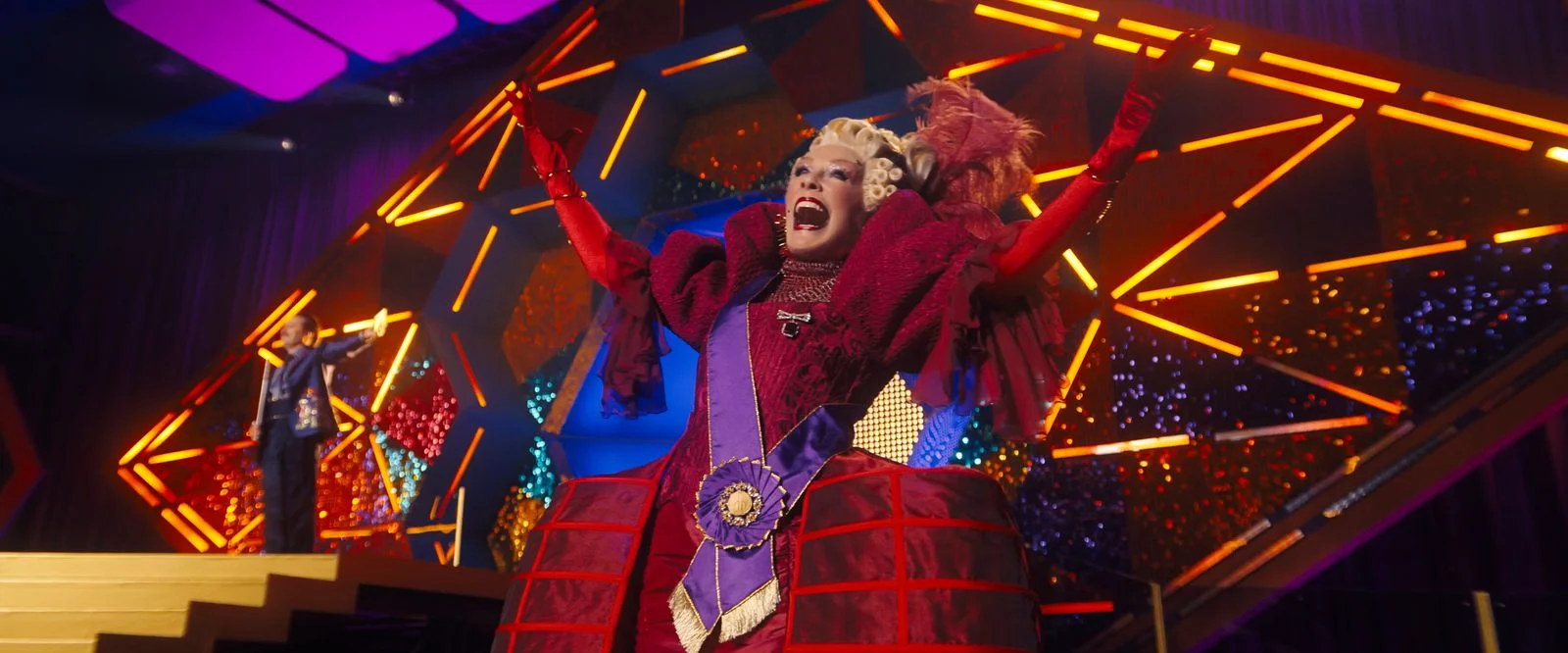
The Capitol's architecture takes the 1970s and pushes it toward spectacle. The design draws on the Roman phrase panem et circenses, "bread and circuses," the source of the nation's name. The buildings are there to keep people distracted and compliant. One of the most striking backdrops is Berlin's International Congress Centrum, a colossal aluminum-clad convention center that opened in 1979. Lawrence calls it "Cold War-era Berlin showing off in a modern way." It was West Berlin's most expensive postwar building, and public money paid for it to display prosperity and technological confidence. That's a fitting stage for a regime that wants its power to look effortless.
The Capitol's power feels safe, and that's part of the point. "It's a time of peace for the Capitol with no rebel attacks, so Snow's had time to build the city up in a way that is an extravagant show of power," Lawrence explains. The chariot parade, where tributes are introduced before the Games, plays out in front of the Berlin Olympiastadion. Werner March designed the stadium for the 1936 Olympics under Nazi Germany, and it was built to project state strength and an illusion of permanence. Setting the Capitol's pageantry there makes the connection to real propaganda hard to ignore.
Plutarch's Mansion
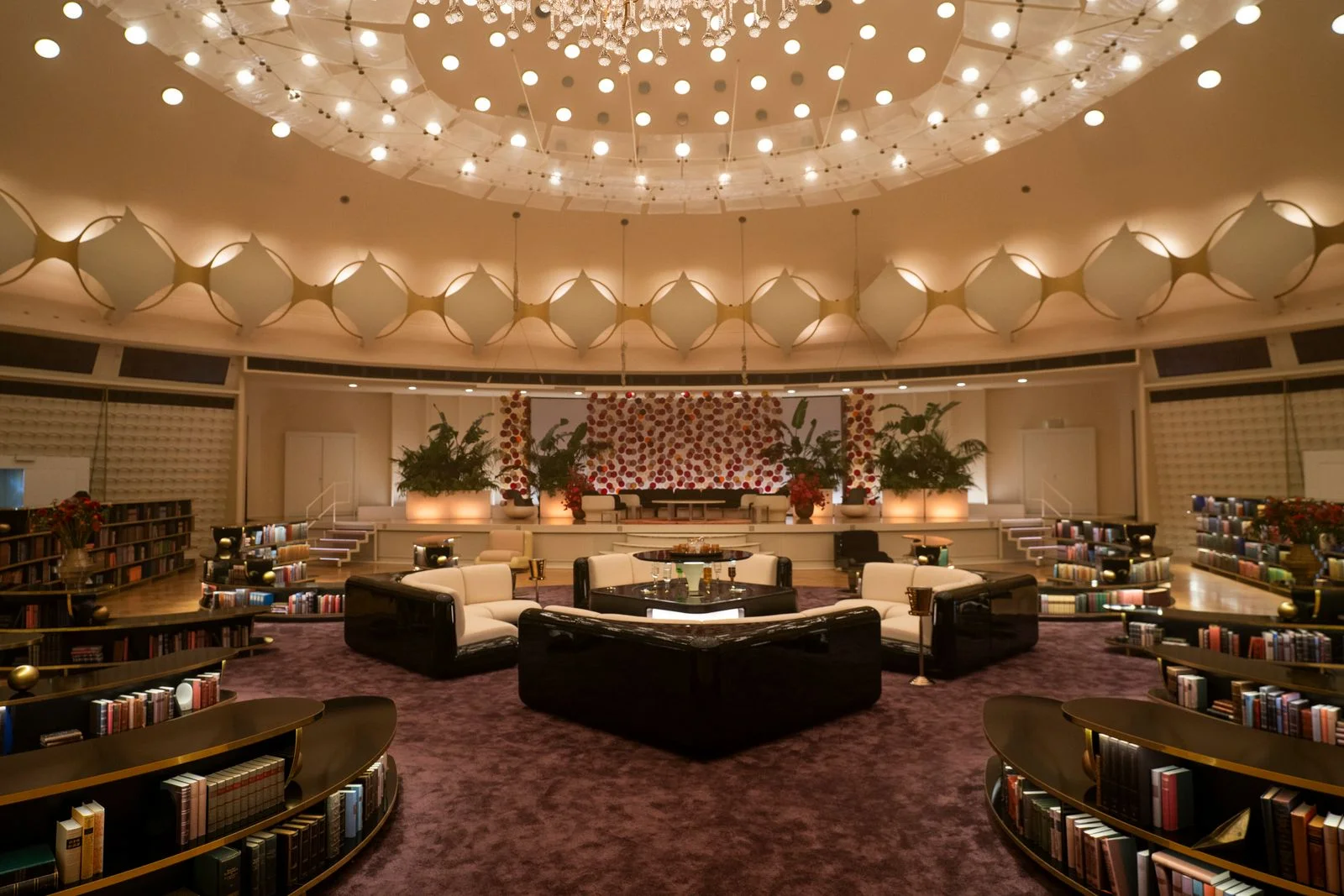
Plutarch Heavensbee's house does more storytelling than most of the dialogue. Jesse Plemons plays the cameraman with old ties to Panem's ruling class, and the production gave him a home that announces the dynasty's wealth before anyone opens their mouth. Lawrence calls it one of his favorite sets: "because of the scope and scale." It was filmed at Berlin's Congress Center, a late-1960s modernist building, and its circular footprint took twenty-five vans of retro-modern furniture to fill. The salon is where Plutarch's own taste shows. Vibrant 1970s furniture and Warhol-inspired art make it feel like a different century from the upstairs library he inherited. That's deliberate. "We wanted to distinguish Plutarch from the dynasty he comes from," Lawrence explains. The library's sheer volume is the joke, and it's a pointed one: the shelves suggest intellectual sophistication that the family may not have earned.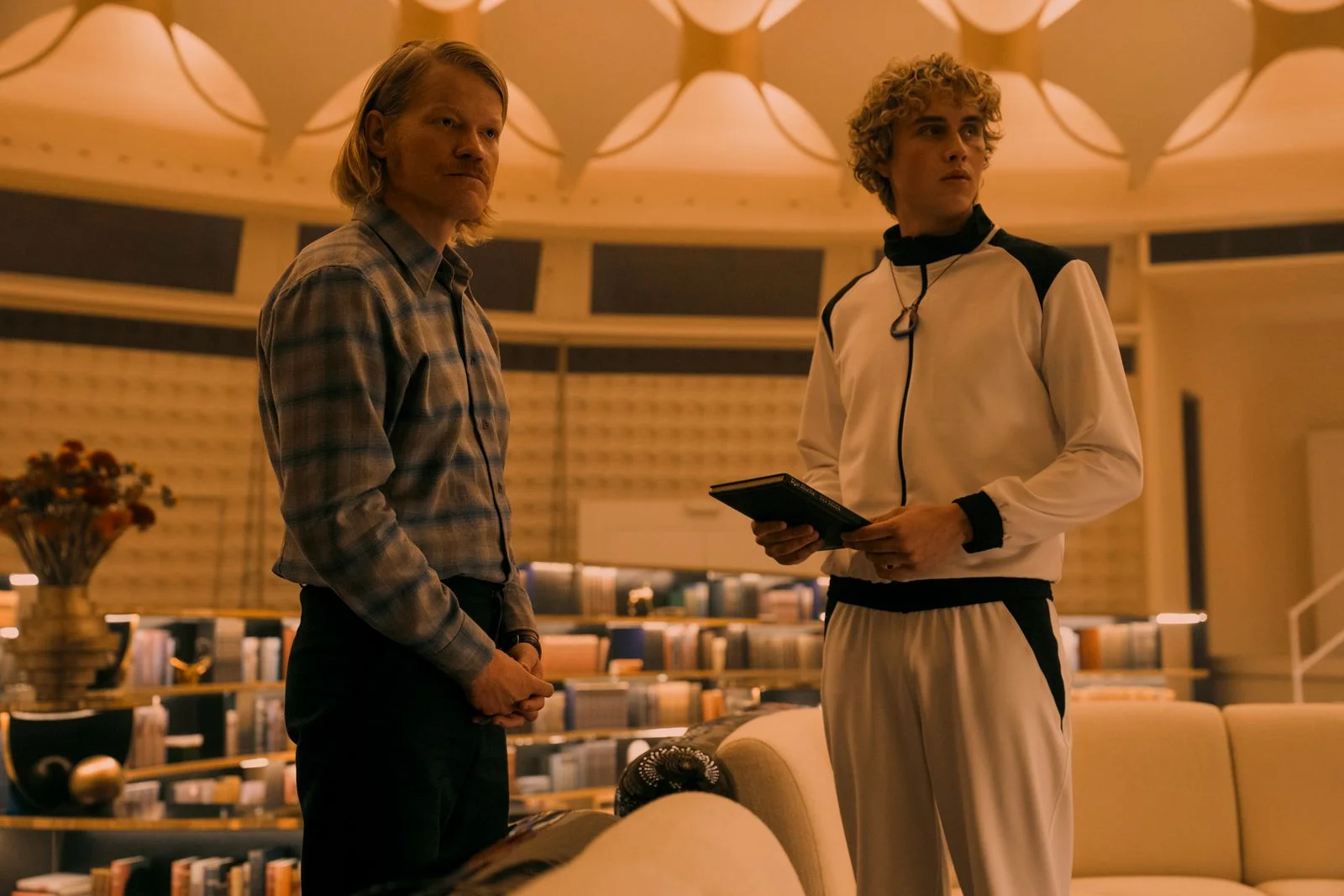
Photo: Murray Close/Lionsgate
The Arena
The arena is where the film's visual argument gets sharpest. Shaped like an eye, the eight-to-ten-mile arena is a direct metaphor for the Capitol's constant surveillance. A golden Cornucopia serves as the pupil, vibrant meadows form the iris, and the surrounding mountains make up the whites. Look at it long enough and you're the one being watched.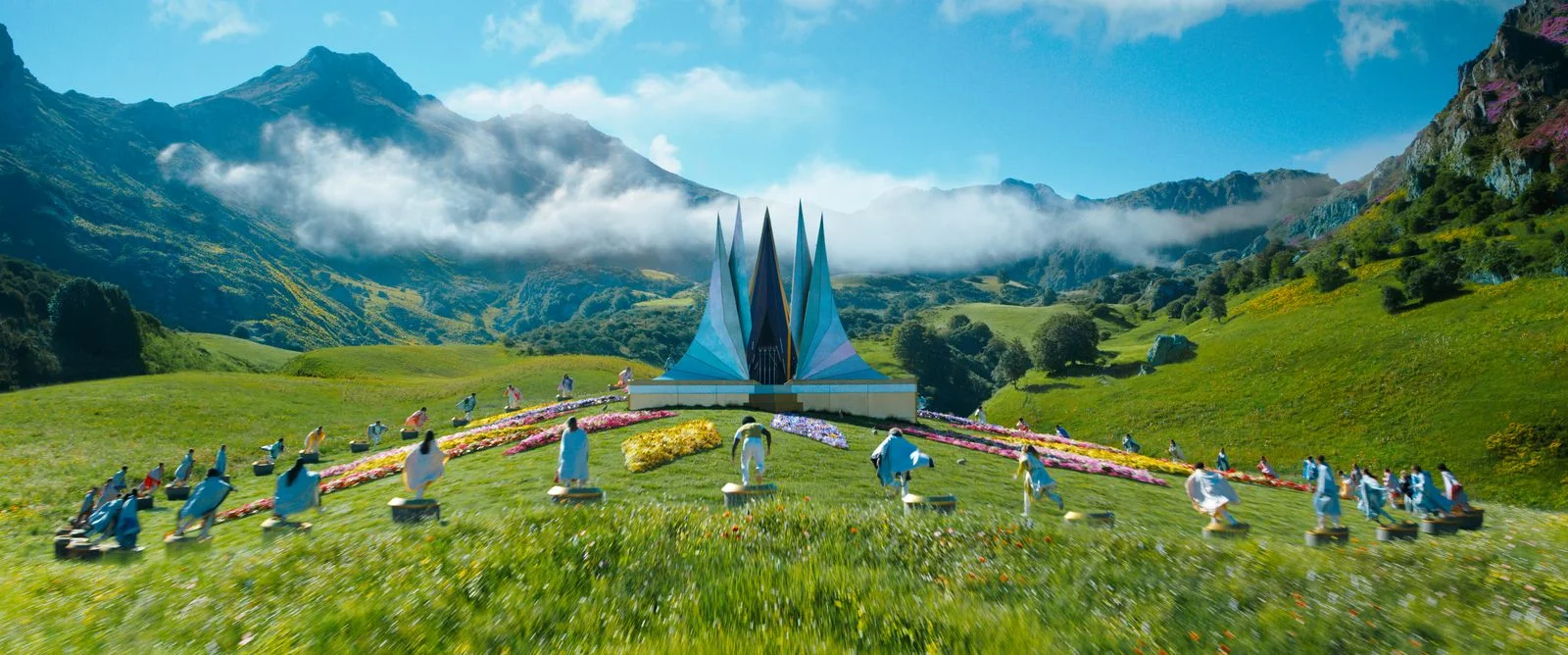
Courtesy of Lionsgate

Photo: Murray Close/Lionsgate
Discussion
Sign in to join the discussion.