Nine states, from Honolulu's ʻIolani Palace to Wyoming's Teton-framed chapel, show how architecture can hold its own against dramatic landscapes.

Nine states, nine very different kinds of beauty. Volcanic beaches, glacier-capped peaks, canyon-carved deserts, and misty rainforests all show up here, and so do the buildings people put up in response: a royal palace in downtown Honolulu, a stone watchtower on the Grand Canyon's rim, and a craft school on the Maine coast clad in cedar shingles. The architecture isn't just decoration. In these states, it holds its own against the scenery, which is a harder trick than it sounds.
Don't expect a ranking to settle which one is most beautiful. Any list like that is really a list of the author's preferences. Every state below earns its spot, so use the list as a travel map, not a verdict.
Hawaii
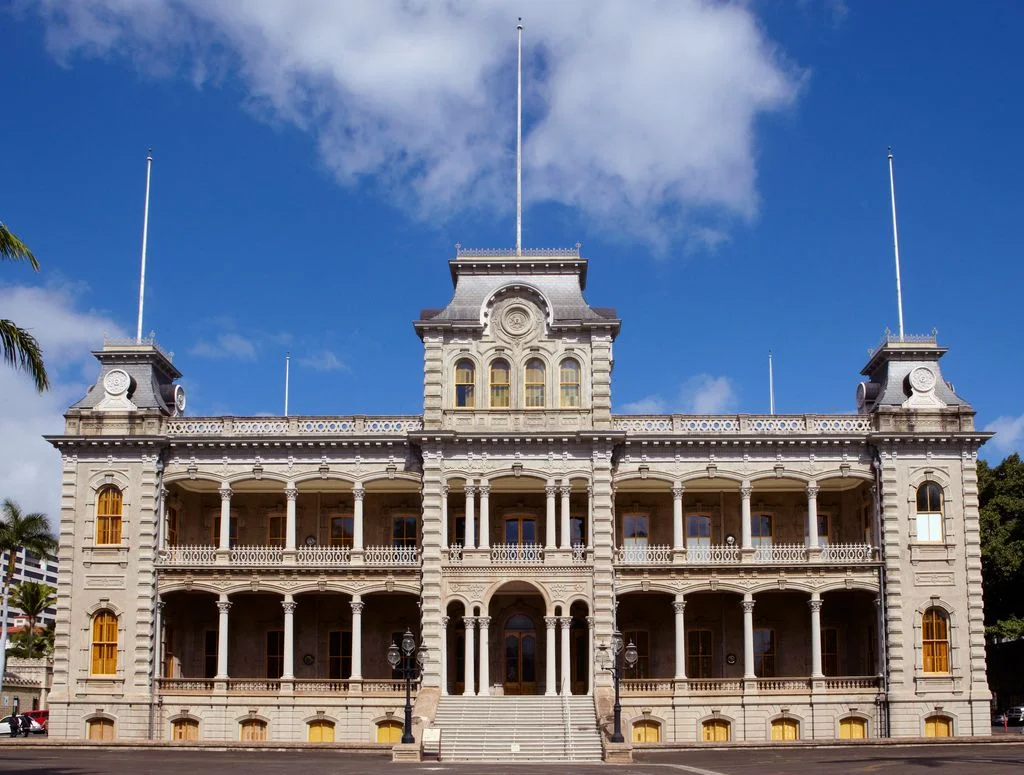
Hawaii doesn't look the same from one island to the next, and that's the first thing to understand about it. On Oahu, in downtown Honolulu, ʻIolani Palace stands out. King Kalākaua had it completed in 1882, and it's the only royal palace on US soil. It had electricity before the White House did, which is a detail that tends to surprise people who assume the palace is the slower technology.
Near Diamond Head, Doris Duke's oceanfront estate, Shangri La, takes a different approach. Its 1930s modernism is paired with architectural elements she brought back from Morocco, Iran, Syria, and farther afield. Today it's a museum of Islamic art, and tours leave from the Honolulu Museum of Art. If you only have one afternoon on Oahu for architecture, this is where I'd spend it.
The natural side of the state is just as varied. Kauai, the Garden Isle, is home to the Nā Pali Coast, where green ridges fall steeply toward the Pacific. On Maui, Haleakalā's broad volcanic summit often sits above a blanket of clouds, which makes it feel more like a different world than an island peak. And on the Big Island, Hawaii Volcanoes National Park puts the raw force of volcanoes on full display. If the timing works out, you might even see an eruption. That's not a guarantee, but it's a real possibility.
Photo: Allan Baxter/Getty Images
Wyoming
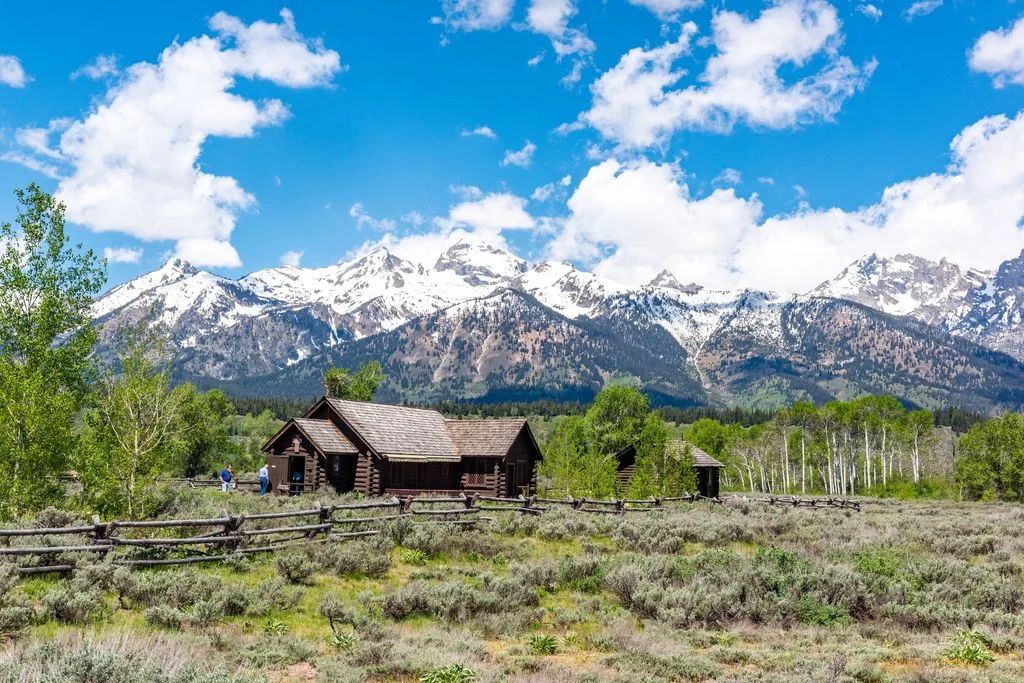
Wyoming's signature shot is the Teton Range rising abruptly out of the sagebrush flats of Jackson Hole. The best version includes one of Mormon Row's weathered homestead barns in the foreground, with the peaks behind it. The sheer drop from flat valley to jagged mountain is what makes the view work, and it's hard to photograph badly.
The small log Chapel of the Transfiguration, built in 1925, is the more interesting piece for anyone who cares about how buildings relate to their surroundings. It was sited so that the picture window behind the altar frames the peaks, placing the mountains where stained glass would normally go. That's a deliberate choice, and an unusually confident one for a small church.
Then there's Yellowstone, where the appeal is mostly about color. Grand Prismatic Spring's vivid rings stand out sharply against the surrounding forest, and the Grand Canyon of the Yellowstone shows off ochres and pinks along its steep walls. Those colors are the first thing most visitors remember.
Steps from Old Faithful, the Old Faithful Inn is the building that matters most here. Robert Reamer designed it when he was 29, and it opened in 1904. Its soaring lodgepole-pine lobby wraps around a massive stone fireplace, and the inn is considered the largest log structure in the world. For a building that's more than a century old, it still makes most modern hotel lobbies look timid.
Photo: Jim Feng/Getty Images
Yellowstone runs on color, and its stone-and-log architecture matches it
Yellowstone is a park that wins on color. Grand Prismatic Spring's vivid rings stand out against the surrounding forest, and the Grand Canyon of the Yellowstone shows ochres and pinks in its steep walls. Those hues are what most visitors come to see first. Steps from Old Faithful, though, the built environment holds its own. The Old Faithful Inn was designed by Robert Reamer when he was just 29, and it opened in 1904. Inside, a soaring lobby of lodgepole pine rises around a massive stone fireplace. It's considered the largest log structure in the world, and it's a reminder that the park's early builders were working with the same raw material as its forests.Florida's architecture gets overshadowed by its beaches
Florida's beaches are the state's most scenic draw, but the buildings are just as distinctive. Ocean Drive in South Beach is the obvious starting point.  *Photo: Alexander Spatari/Getty Images* In 1979, [Miami Beach's Art Deco District](https://www.architecturaldigest.com/gallery/art-deco-miami), roughly a square mile of South Beach, became the nation's first urban 20th-century historic district on the National Register. More than 800 buildings made the list. That's a lot of pastel facades to protect, and the designation is why they're still there. Across Biscayne Bay, Vizcaya tells a different story. Industrialist James Deering completed the villa in 1916, and its formal gardens, designed by Diego Suarez, face the water. Further north, Addison Mizner gave Palm Beach its Mediterranean Revival character. His Via Mizner, a winding pedestrian lane off Worth Avenue built in 1923, is still in use today. St. Augustine, founded by the Spanish in 1565, offers a deeper timeline. The coquina-stone Castillo de San Marcos anchors the city's history, while Henry Flagler's Hotel Ponce de Leon sits nearby. Built in 1888 in a Spanish Renaissance–style, the palace is now Flagler College. Here's the thing: few cities put a 16th-century fort and a Gilded Age resort this close together, and the contrast is the point. If you care about modern architecture, detour to Lakeland. Frank Lloyd Wright's campus for Florida Southern College is the largest single-site collection of his work in the world. It's an easy place to underestimate until you've walked through it. On the Gulf Coast, Sarasota's midcentury modernists took the International Style and adapted it to the subtropics. The result is more than a stylistic transplant. Paul Rudolph's 1953 Umbrella House is the best-known example, and it shows how the region's climate forced the designers to rethink the rules.Maine's coast pairs granite with shingle and craft
Maine's coast looks rugged on the surface, but the detail rewards a closer look. Acadia National Park fits granite headlands, spruce forest, offshore islands, and Atlantic views into a relatively small area. Then there's the stonework, which is easy to miss.  *Photo: Enzo Figueres/Getty Images* John D. Rockefeller Jr. financed the park's carriage roads, built between 1913 and 1940, along with 16 of the 17 stone-faced bridges that carry them over streams and gorges. None of the bridges are alike. If you only come for the views, you'll miss one of the park's more deliberate design decisions. The coastal villages are worth the detour too. Bar Harbor is ever-popular for good reason, and its shingle-style and Queen Anne houses reflect a very different era of seaside money. Stonington, on Deer Isle, is something else entirely: a working fishing town that still feels like it belongs to the water rather than to visitors. Elsewhere on Deer Isle, Edward Larrabee Barnes's 1961 campus for the Haystack Mountain School of Crafts is underrated. Calling it an underrated masterpiece of American modernism is a fair read. The campus steps down a granite slope toward Jericho Bay, with cedar-shingled cabins and studios connected by boardwalks. It's a quiet building, and that's exactly why it works.Variety is the real story
California doesn't have one architectural identity. It has several, and they barely overlap. Los Angeles and San Francisco bring dense urban design, while the coast offers something closer to theater. Pick one and you'd miss most of the state. Yosemite is the obvious draw. El Capitan and Half Dome look dramatic from the valley floor, and they look even more daring from the top, for the climbers who make it. Down in the valley, the Ahwahnee hotel, which opened in 1927, appears to be built from granite and redwood. The "wood" is actually fireproof concrete, poured into molds and stained to pass as timber. It's a clever trick, and a slightly unsettling one. Photo: Jeremy Poland/Getty Images
Then there's the desert. Palm Springs became a showcase for midcentury modernism, and Richard Neutra's 1946 Kaufmann House remains its best-known example. If you're looking for proof that clean lines and open glass can work in extreme heat, this is where to start.
The coast is where the state's reputation really gets made, though. Highway 1 covers 656 miles, and the architecture arrives right alongside the views. Above San Simeon, Hearst Castle sits on a hilltop over the Pacific. Julia Morgan designed it for William Randolph Hearst over nearly three decades, and it shows: it's ambitious to the point of excess.
Keep heading north and the tone shifts. Past the bluffs of Big Sur and the storybook streets of Carmel-by-the-Sea, the Sea Ranch on the Sonoma Coast takes a different approach. Begun in the mid-1960s, this planned community uses redwood-clad buildings tucked into hedgerows, leaving the meadows and bluffs largely open.
That's the lesson worth carrying away. The most memorable California architecture tends to step back from the land rather than compete with it. Hearst Castle makes a statement. The Sea Ranch lets the scenery do the talking, and that restraint is harder to pull off than it looks.
Discussion
Sign in to join the discussion.