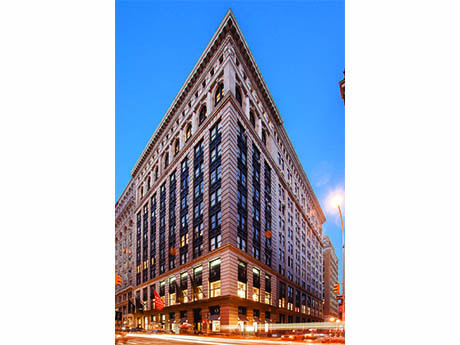
The 390,745-square-foot SoHo building refinanced for $216 million, with its 70,870 square feet of retail fully leased to tenants including Hugo Boss and Equinox.
Refinancing a fully leased SoHo building
The notable detail in the $216 million refinancing of 568 Broadway is the tenant roster: the SoHo property combines fashion and fitness retailers with office users including Zocdoc, The Farmer’s Dog and Milk Makeup. Walker & Dunlop arranged the bridge loan through ACORE Capital for the 390,745-square-foot, 12-story building. That mix gives the refinancing a broader story than the loan amount alone: the property brings together several kinds of commercial demand under one roof. It’s a useful reminder that a building’s leasing picture can’t be read from one tenant category in isolation.
Retail accounts for 70,870 square feet and was fully leased when the loan closed. Hugo Boss, Athletic Propulsion Labs, GU and Equinox are among the retail tenants. That occupancy is a useful snapshot, though the announcement doesn’t explain the loan’s terms or how the building’s office space is performing. Full retail occupancy is a concrete data point, but it doesn’t tell readers what rents tenants are paying, how long their leases run, or whether the space is producing the income the borrower expects. Those details matter when assessing a refinancing, particularly for a property whose uses may face different leasing conditions.
A team of eight Walker & Dunlop professionals arranged the financing: Aaron Appel, Dustin Stolly, Jonathan Schwartz, Keith Kurland, Adam Schwartz, Sean Reimer, Jordan Casella and Stanley Cayre. The borrower is a joint venture of Aurora Capital, Allied Partners and A&H Acquisitions. For a property with both retail and office tenants, the reported retail leasing gives only part of the picture. The building’s scale and tenant mix make the missing office information especially relevant to understanding what supports the new debt.
What the tenant mix tells us
Retail and office space can contribute to a property’s cash flow in different ways. Retail leasing is often closely tied to storefront visibility, customer access and the appeal of a particular shopping area. Office leasing, by contrast, can depend more on a tenant’s space needs, workplace plans and lease commitments. Those are broad distinctions, not a verdict on 568 Broadway: the announcement doesn’t provide enough information to judge the strength or stability of either category here.
The named tenants do establish that the property serves a varied set of businesses. Fashion, fitness and consumer brands sit alongside office users from other sectors. That spread may reduce dependence on a single type of tenant, but variety alone doesn’t prove that income is secure. A lender or owner would also look at lease expirations, rent levels, tenant credit, renewal options and the amount of space each tenant occupies. None of those details is included in the refinancing announcement.
And this is the part most people overlook: “fully leased” describes occupied space at a particular point in time, not necessarily the future performance of that space. A retail floor can be leased while still facing upcoming expirations or costly tenant improvements. The same principle applies to offices. Without lease terms, occupancy figures for the office component and operating details, readers can’t determine how much of the property’s revenue is covered for the longer term.
What a bridge loan signals—and what it doesn’t
The financing is described as a bridge loan, a category generally used to provide debt for a property during a period when ownership is pursuing a next step. Depending on the circumstances, that can include stabilizing income, completing a business plan or preparing for a later financing. The label by itself doesn’t disclose which purpose applies here, how long the loan runs or what conditions the borrower must meet. The announcement gives the loan amount and names the lender and arranger, but not the structure behind the transaction.
That absence limits what can be concluded from the headline figure. A refinancing replaces or restructures existing debt, but the release doesn’t state the prior loan balance, the new interest rate, the maturity or whether the proceeds include additional capital. Those terms help explain how a transaction fits the property’s operating position. Without them, the $216 million figure is informative about scale, but it doesn’t show how much financial flexibility the deal provides or how the lender evaluated the building’s income.
This is more significant than it looks. For a mixed-use building, a lender’s assessment may depend on how different parts of the property perform together, including whether strong leasing in one area offsets weakness in another. That general underwriting question is relevant to 568 Broadway, but the public information doesn’t reveal the lender’s analysis. The retail space being fully leased is encouraging as a snapshot; it can’t stand in for the performance of the entire building.
The limits of the announcement
The property’s reported area, story count, retail footprint, tenants and transaction parties offer a clear outline of the deal. They don’t provide a full operating profile. Readers still lack details about office occupancy, lease duration, tenant concentration, expenses and the building’s recent leasing history. These are standard pieces of context in commercial property analysis because they help distinguish a headline occupancy figure from the durability of a property’s income.
The distinction matters for owners, lenders and anyone tracking commercial real estate activity. A fully leased retail component can indicate that tenants are committing to the space, but it doesn’t answer whether those leases are at sustainable rents or whether renewals are likely. Nor does a list of office tenants show how much space they occupy or when their agreements expire. Here’s the thing: tenant names make a transaction easier to picture, while the underlying lease data tells a more complete financial story.
If you’re working in this space, the useful next questions are straightforward: how much of the office area is occupied, when do leases roll, and what are the loan’s term and pricing? The announcement doesn’t answer them. That gap doesn’t diminish the confirmed retail leasing, but it does set a limit on how much the refinancing can tell us about the building’s operating health.
Why the deal merits attention
568 Broadway is a sizable property with retail and office uses, and its refinancing places those uses inside a single financing story. The reported retail tenants provide a visible account of the building’s storefront appeal, while the office roster points to a separate source of demand. Yet the release gives no basis for weighing those contributions against each other. A fuller account would need leasing and debt details, not just a list of tenants and the amount borrowed.
For now, the clearest takeaway is limited but useful: the retail portion was fully leased at closing, and the building has a varied mix of retail and office occupants. The bridge loan confirms that a major refinancing was arranged, though its terms and the office component’s performance remain undisclosed. The next meaningful measure will be whether the property can sustain occupancy and income across both uses. Until more operating detail is available, the headline describes a substantial transaction, not a complete read on the building’s prospects.
Discussion
Sign in to join the discussion.