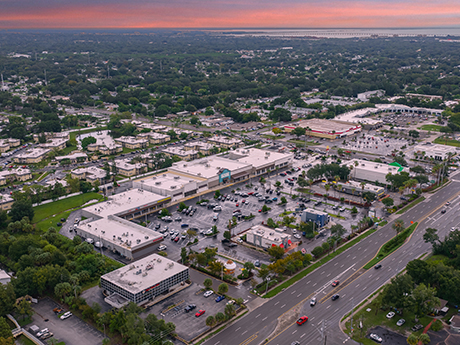
MCB acquired Largo’s 81,272-square-foot Keene Plaza, anchored by Sprouts Farmers Market and BioLife Plasma Services and renovated in 2025.
MCB acquires renovated Largo center
MCB Real Estate has bought Keene Plaza, an 81,272-square-foot shopping center at 2150 East Bay Drive in Largo, Florida, about 23 miles northeast of Tampa. Its grocery anchor gives the property a familiar retail foundation: grocery stores can draw repeat visits, while neighboring tenants may benefit from customers already coming to the center for food. A 2025 renovation also means the new owner is taking over a recently upgraded property. The acquisition price and seller weren’t disclosed, so the transaction offers little basis for judging its value or comparing its terms with other retail sales.
The purchase is a straightforward example of a pattern seen in neighborhood retail: buyers take on a center built around recurring local needs, then manage the mix of shops and services around that anchor. That approach can make a property’s daily purpose easier to understand, but it doesn’t guarantee steady performance. Tenant demand, lease terms, operating costs and the condition of the property all affect how well the pieces work together. In Keene Plaza’s case, the reported tenant roster and renovation scope provide a useful outline, though they don’t reveal current occupancy, rent levels or leasing plans.
A mix of daily needs and services
Sprouts Farmers Market and BioLife Plasma Services anchor the property. The other reported tenants include McDonald’s, Little Caesars, Dollar General, Hibachi Express, The Corner Skillet and Corner Wash Laundry. That lineup spans grocery, dining, discount retail and services, giving the center a broader tenant mix than its grocery-anchored label alone suggests. The tenant list points to a property designed to serve more than one kind of visit: grocery shopping, meals, laundry and other services can bring different customers at different times.
That mix can matter to a center’s day-to-day appeal. Grocery tenants are often treated as traffic anchors because shopping for food is a recurring need, while restaurants and service businesses can give customers additional reasons to stop. But a roster is only a snapshot. It doesn’t tell readers how much space each business occupies, whether every listed tenant is currently operating, or how the leases are structured. Those details would be needed to assess the center’s income profile or how much its performance depends on any one tenant.
BioLife’s presence also adds a service use alongside traditional retail. This kind of tenant can broaden the reasons people visit a shopping center, though its role in the property’s overall performance can’t be assessed from the available information. The same caution applies to the restaurants and laundry business: their presence shows variety, not necessarily the strength of their sales or the duration of their leases. A list of recognizable businesses is useful, but it isn’t a substitute for operating data.
Here’s the thing: tenant variety can make a center feel more useful to nearby customers, yet it also means the owner has to manage different business needs across the property. A food retailer, a restaurant and a service provider may place different demands on access, building systems and the surrounding common areas. The reported mix gives MCB several categories of tenants to work with. Whether that diversity translates into durable leasing performance remains unanswered.
Renovation gives the buyer a refreshed starting point
Keene Plaza was renovated in 2025. Work covered the façades, parking areas, lighting, retail suite interiors, mechanical systems and roofs. The scope touches both visible parts of the center and building components that affect how tenants use their space. For an incoming owner, that can provide a more recently updated physical asset to operate and maintain.
Still, a renovation date doesn’t explain the condition of every system or how much work might be needed in the future. The source doesn’t describe the project’s cost, whether all suites were updated, or whether the work addressed any specific operating problem. Nor does it say whether the renovation changed occupancy or leasing performance. The upgrades should be understood as a property improvement, not as proof that the center’s commercial results have improved.
Parking and lighting are part of a retail center’s basic function, shaping how customers reach stores and move around the site. Façade work can affect the property’s appearance, while suite interiors and mechanical systems relate more directly to tenant spaces and building operations. Roof work addresses another major part of the physical asset. These categories help explain why a broad renovation may matter to an owner, but the source doesn’t provide enough detail to judge the quality or remaining useful life of the work.
And this is the part most people overlook: capital work can reduce the number of immediate repair needs without removing the ongoing costs of owning a shopping center. Buildings still require maintenance, and tenant spaces can need attention as businesses change. The reported renovation gives MCB a more recent upgrade cycle to start from. It doesn’t make the property maintenance-free.
What the acquisition does—and doesn’t—show
The deal places MCB in control of a grocery-anchored center with a mix of food, discount retail and service tenants in Largo. That combination is a recognizable format in neighborhood retail, where a central draw can support smaller businesses around it. This is more significant than it looks: a center’s value to its surrounding area often comes from the ordinary errands it supports, rather than from a single headline tenant or a dramatic redevelopment plan.
That said, the available facts leave important questions open. There’s no disclosed acquisition price, seller, occupancy figure, leasing history or operating performance. Without those details, readers can’t tell whether MCB bought the property at a discount, paid a premium for its renovated condition, or expects to make further changes. Those would be guesses, not reporting.
If you’re working in this space, the practical signals to watch are the center’s tenant stability, leasing activity and upkeep after the sale. The acquisition and renovation provide a starting point, but the next phase depends on how the property performs in use. A broad tenant mix can help a center meet varied needs; it can also obscure uneven results among individual businesses. The available account establishes the property’s basic profile, while leaving its financial and leasing story largely undisclosed.
Discussion
Sign in to join the discussion.