London’s luxury housing market has seen unparalleled growth in transactions and value in the first half of 2021, driven by domestic buyers seeking larger homes.
London’s super prime residential market has experienced an impressive uptick in both transaction volume and value, achieving the strongest performance since 2014. This surge comes in stark contrast to the quieter periods observed during the pandemic's early stages. In an environment where economic uncertainty has been prevalent, the resilience of this segment reinforces its unique status within London's broader property market.
Transaction Volume and Value Trends
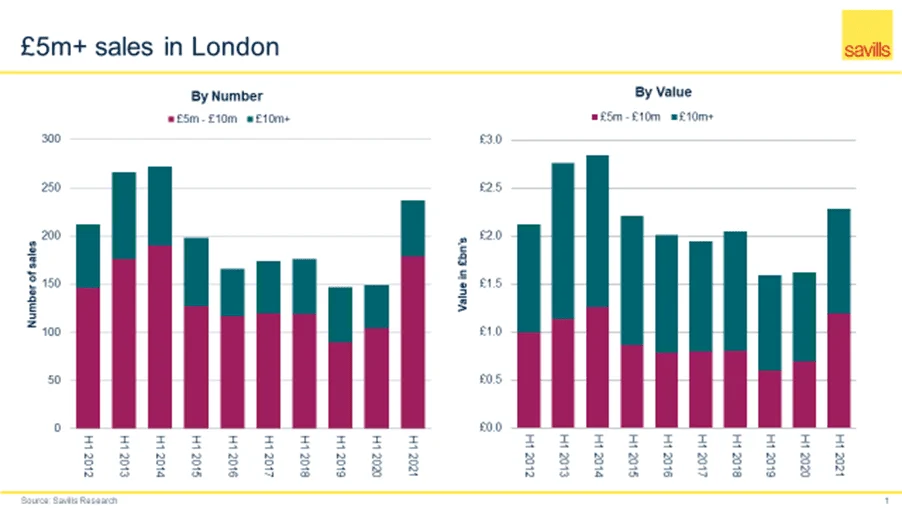
According to Savills, a total of 237 transactions for properties costing over £5 million were recorded in the first half of 2021. This figure represents a remarkable 59% increase over the same period in 2020 and a 61% rise compared to 2019, when market conditions were more typical. The total value of these transactions reached £2.28 billion, marking an increase of 41% from last year and 43% from two years ago. These numbers are striking, particularly when cut against the broader economic backdrop. High-net-worth individuals seem to be finding ways to allocate their capital, even amid uncertainty. Such a trend might signal a decoupling from traditional market pressures on luxury assets.
Buyer Demographics and Motivations
Domestic buyers and those already residing in London have been the primary drivers of this market rebound. Many have shifted their priorities towards larger homes and gardens, a response to the restrictions and lifestyle changes brought about by lockdowns. This is more significant than it looks; it reflects a fundamental change in how people value space, especially in urban areas where luxury often comes at a premium. Notably, the price range of £5 million to £10 million experienced a marked boom, with 179 transactions recorded—almost double the amount compared to the first half of 2019, and up from 104 in the same timeframe last year. Buyers are increasingly prioritizing lifestyle facets over traditional investment metrics.
High-End Market Stability
Meanwhile, the transactions in the £10 million-plus category have remained stable, indicating resilience. In fact, there were 58 sales in the first half of this year, maintaining pace with the 57 sales from 2019, compared to just 45 in the early pandemic phase of 2020. The total value for this price segment also improved, reaching a noteworthy £1.08 billion against £0.99 billion in 2019 and £0.93 billion in 2020. This stability suggests that high-end properties continue to attract serious buyers, undeterred by the surrounding economic fluidity. Here’s the thing: while other sectors may waver, the super prime category remains anchored by wealth rather than whims.
Impact of International Buyers
Frances Clacy, a residential research analyst at Savills, highlights that while London-based buyers have successfully navigated the market with minimal competition, the absence of international buyers has impacted certain prime areas, keeping prices approximately 20% lower than their peaks. The gap left by overseas purchasers is palpable, particularly in districts renowned for their cosmopolitan appeal. Demand for larger homes has outpaced that for flats, which continue to struggle due to restrictions on international travel. (And this is the part most people overlook) — flats historically command a stable rental yield but have been hit hard by the pandemic's shifting priorities regarding living space.
Anticipating Future Demand
As travel opens up, a shift toward demand from overseas buyers is anticipated. Savills foresees a rapid closing of this opportunity window once travel restrictions ease. Their index indicates growth across all prime London areas, projecting a 21.6% increase in prime central London values by the end of 2025, despite the extended limits on international arrivals. Such a forecast indicates that the current momentum is not only a transient spike but rather a precursor to sustained growth, particularly if foreign investment returns with vigor.
Geographical Insights in Luxury Sales
Most £5 million-plus transactions have occurred in central London boroughs, which comprise 89% of sales. Chelsea and Kensington have dominated, capturing 14% and 13% of deals, respectively. However, outer London areas like Putney and Wimbledon are making strides in this high-end market, collectively accounting for 11% of these luxury sales. Notably, there’s been significant yearly price growth of 9.0% for larger homes in west London and 8.2% in the southwest, suggesting that demand for spacious living in urban settings continues to thrive. These shifts highlight a broader trend where buyers are increasingly seeking value beyond traditional hotspots.
Pricing Trends In Prime Central London
In prime central London, price growth remains modest, with neighborhoods like Notting Hill, Holland Park, and Bayswater reporting annual increases between 3.2% and 4.1%. This slow but steady increase reflects a level of stability amid volatility while underscoring a shift in demand as buyers reassess their priorities in light of recent experiences. If you’re working in this space, these pricing trends could indicate which areas might adjust rapidly as the market recovers fully.
Future Outlook
The trajectory of London's super prime residential market leaves much to speculate about. Will the return of international buyers spark a further boom, or will we witness a plateau as local demand shifts back? The implications are significant; how the market adapts to evolving buyer preferences will shape its future dynamics. Analysts will carefully monitor the interplay of domestic and international interests as we move into the next phases of economic recovery.
Discussion
Sign in to join the discussion.