A 1976 tour of Truman Capote’s secluded Sagaponack home offers clues to nearly 400 belongings headed to auction in Bellport.
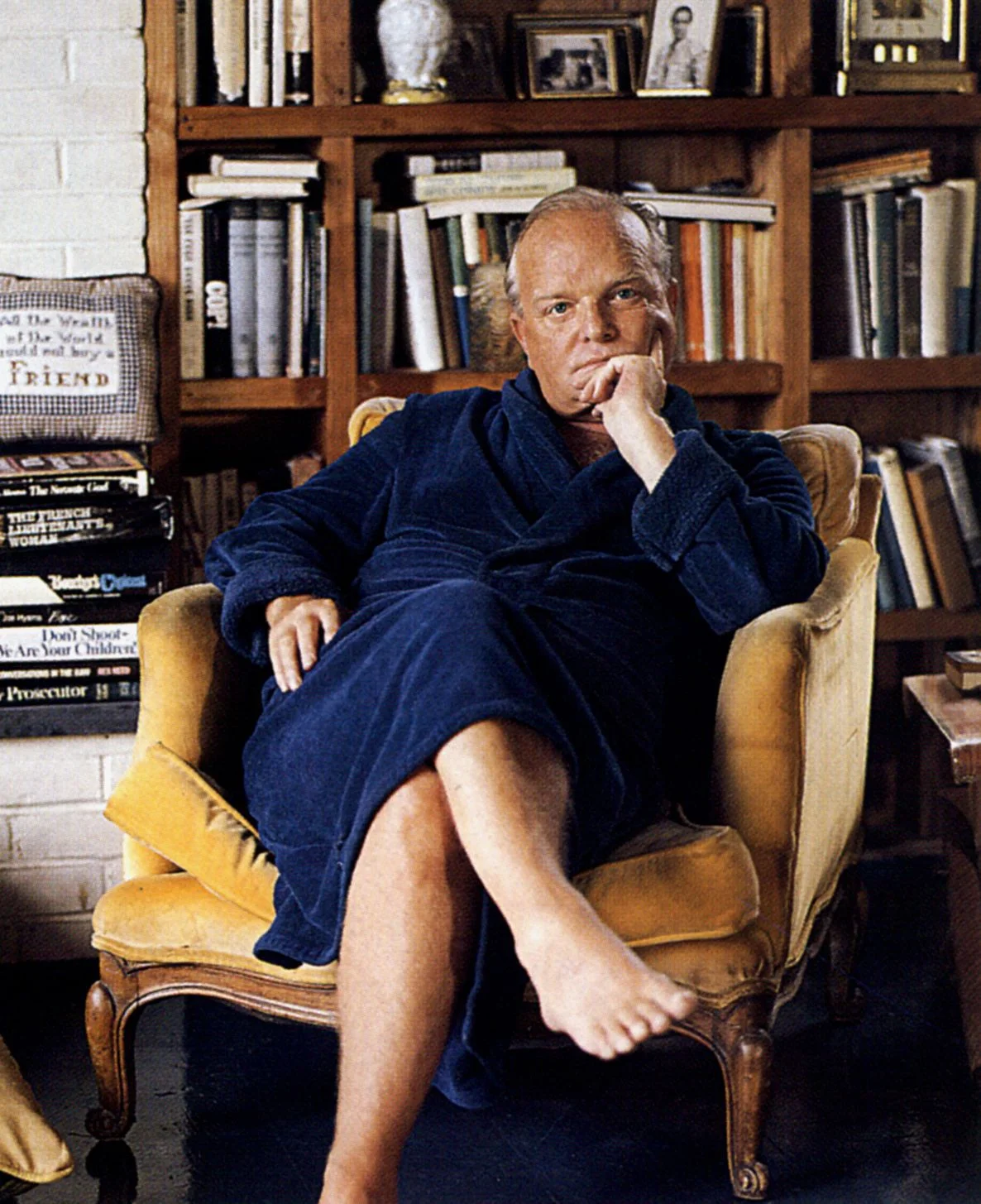
Truman Capote’s Hamptons House, Seen Before Its Contents Go to Auction
Nearly 400 objects connected to Truman Capote are headed to auction, and the 1976 Architectural Digest feature on his Sagaponack home offers a useful guide to what may appear. The sale gives the writer’s possessions a new audience, but the house itself explains why the objects matter: they belonged to a place Capote shaped around privacy, books, and his own particular sense of humor.
Capote died in 1984, aged 59. Many of his belongings went to Gerald Clarke, the journalist and friend who published a biography of Capote in 1988. Clarke, now 89, is downsizing and has consigned the objects to Cornell Auction in Bellport, New York. The sale is scheduled for November 21, with an online preview and bidding set to begin October 26. The complete catalogue hasn’t been released.
In an Instagram video, the auction house said most of the items were photographed nearly 50 years ago for an Architectural Digest story about Capote’s home in Sagaponack, on Long Island. That connection makes the old photographs more than a nostalgic house tour: they may help readers spot pieces now coming to market.
Among them are paperweights, a collection Capote became “addicted to,” Clarke told The New York Times. Some preserve flowers in resin; Capote made some himself. One contains rocks from the Kansas farm associated with In Cold Blood. Other reported lots include a signed copy of Harper Lee’s To Kill a Mockingbird, a longtime friend’s gift; a bronze frog inkwell; and Capote’s house keys.
Capote’s life has since been dramatized in the 2005 film Capote and the 2024 miniseries Feud: Capote vs. the Swans. For the home and its history, though, the original tour is the more direct record. It was written by Rosemary Kent and photographed by Jaime Ardiles-Arce. The images below offer a chance to revisit the house—and to keep an eye out for objects that could soon be available to bid on. For more on the home, see Architectural Digest’s earlier Capote tour.
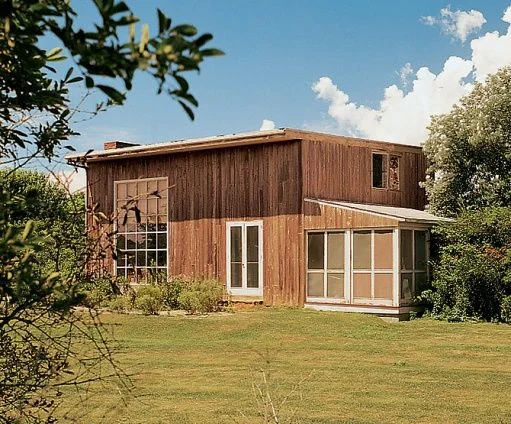
Finding Capote’s Long Island house was difficult by design. Tucked behind scrub pine, privet hedges, and hydrangeas near Sagaponack, the two-story beach house had weathered gray boards and little interest in announcing itself.
He lived among potato fields and farms close to the Atlantic, in a community shared by year-round residents and summer visitors from the city. Old farmhouses and modern glass homes competed for space among the dunes and fields. Capote once described Sagaponack as “Kansas with a sea breeze.”
The area had drawn artists and writers including James Jones, Willem de Kooning, Marya Mannes, Jean Stafford, and Joseph Heller. Capote could lunch or have a drink with fellow writers John Knowles and Willie Morris at the local bar; the town newspaper even ran a birthday greeting for him. He was free to come and go without making a spectacle of himself.
The approach was part of the house’s privacy. Capote drove a deep-green Buick down a bumpy dirt lane first opened in 1670, then turned onto a gravel drive that passed a bird sanctuary and a friend’s cottage on his land. The house came into view among wildflowers, with potato fields nearing harvest and salt air coming off the Atlantic.
Capote said he owned six acres and had the house built to his specifications in 1962 by a local carpenter. “I work at this untended look,” he said. “It’s intentional.” He valued the quiet and the distance from neighboring houses: “This is a place to be alone.” Only a handful of friends had made their way up the overgrown path, and each had been invited.
Capote’s Sagaponack house makes his priorities unusually plain: he came there to work, and he arranged the place to protect that routine. He favored autumn and winter, when the area was quiet, and found the summer crowds—and the nightly social circuit—hard to understand. The man known for moving among prisoners, princesses, socialites and sailors, and for being both a major American writer and a celebrated social presence, preferred long stretches alone.
“I spend most of my time out here reading, writing, going for walks with my dog and talking on the telephone,” he said. He rarely entertained: in 14 years at the house, he had gone out to dinner just six times. New York friends stayed in the city, and Capote reckoned he knew only about four people he would invite over. His routine depended on that distance. He rose around 7 a.m., worked until lunch at 1, then handled errands, visited the post office and walked. Evenings were for reading and walking Maggie; dinner came by 7, and he was usually in bed with a book by 9:30.
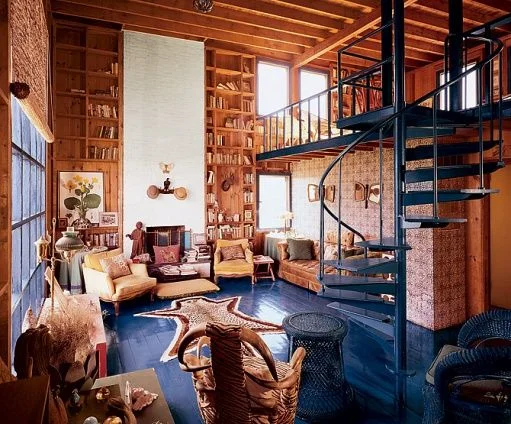
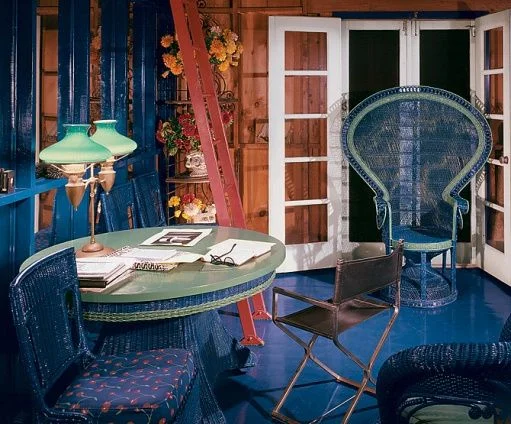
The house itself suited the schedule. Capote called it a “raincoat”: its exposed vertical studs and horizontal braces formed an outer skin around the interior. He wanted a rustic, fully winterized place that looked unfinished, with the feel he called “run-down comfort.” He thought of it as one large room, where rough wood met mirrors. A marine-blue floor, freshly painted with boat-deck paint, was still drying in the humidity. At night, he said, it looked like “a big blue-green lake.”
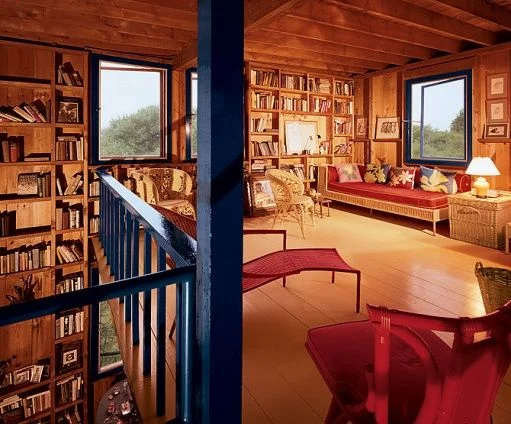
A broad divided-pane window brought morning sun into the living room and framed the sea and sand about 200 yards away. A steel spiral staircase climbed to a gallery and a second-floor study, furnished with red sofas, wicker chairs and hassocks, with a well-known René Bouché sketch of Capote. That was where he read and worked on Answered Prayers, the long-awaited novel then in progress.
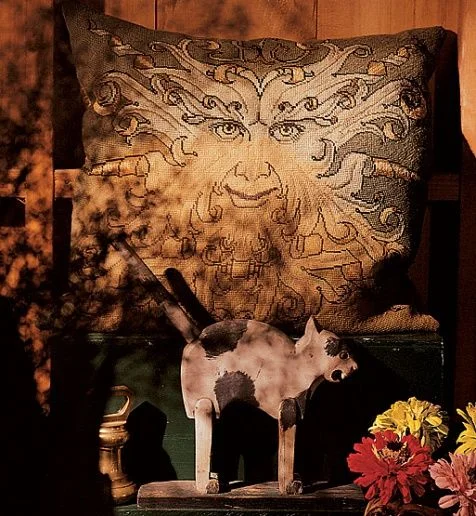
Nothing in the rooms seemed reserved for display. A Tiffany lamp stood behind a worn yellow velvet chair; the upholstery had faded in places, while paperweights gleamed on nearby surfaces. Capote mixed inexpensive wicker from import shops with rare antiques, including a round, claw-footed table where he wrote. Friends’ needlepoint pillows and silver-framed photographs—including images of Lee Radziwill in a bumper car and of Maggie—made the rooms personal. Maggie, his English bulldog, was visiting next door at the time. Capote called her “sweet, quirky and huggy”; she had eaten Joanne Carson’s pink satin slippers and Charlotte Curtis’s poinsettias, and sometimes raided picnickers’ baskets on Gibson Beach. “Oh, she’s very munchy all right,” he said, pushing up his blue-tinted prescription glasses and giggling.
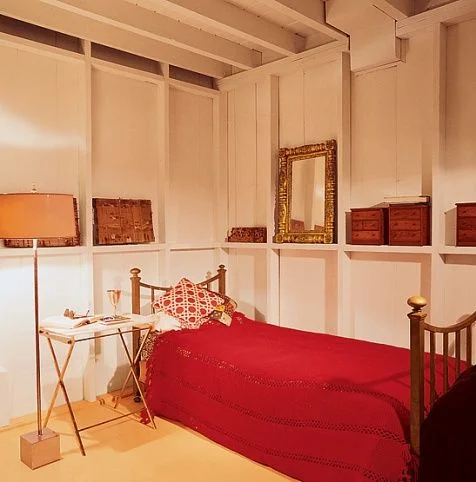
Near the kitchen, the bedroom was almost tent-like in its simplicity: a cot-size bed, favorite books, detective magazines and a reducing machine. By contrast, a small screened porch off the living room offered a summer retreat, furnished with wicker and open to mild sea breezes. Capote liked having his own belongings around him, even at his houses in Switzerland and California. His permanent base, though, was a sleek apartment at Manhattan’s U.N. Plaza. He said he made an excellent houseguest because he appeared only at mealtimes; hosting others, he joked, was an interruption.
That preference for control extended to the interiors. Capote designed them himself and said he knew what he wanted, finding decorators unnecessary. His test for good design was dryly modest: a room should be “not immediately offensive when you walk into it”—though, he added, it might become so eventually. He collected Victorian objects and enjoyed combining them, while admitting he had accumulated too much and had not recently edited his collection. The result feels less like a staged country house than a working home, shaped by use, habit and a writer’s need to be left alone.
Work also followed him into the public eye. He had recently completed his first film role in Neil Simon’s Murder by Death, playing Lionel Twain, an eccentric millionaire in a gloomy New England Victorian mansion and an authority on detective fiction. Capote called the casting perfect, given his interest in crime and the success of In Cold Blood. The ensemble included Peter Sellers, Orson Welles, Myrna Loy, Eileen Brennan, Peter Falk, David Niven, Madeline Kahn, James Coco and Nancy Walker. Capote was delighted to have the lead.
For Capote, home seemed to mean a familiar collection of rooms and objects more than a fixed address. Born in New Orleans and raised in the South, he moved often as a child; he recalled feeling at home in a rural Alabama town when he was 11. In Breakfast at Tiffany’s, he had written, “I am always drawn back to places where I have lived, the houses and the neighborhoods.” Sagaponack offered that pull, even if his own definition remained wryly portable: “Home is where I hang my hats.” He pointed to his rumpled panamas above the brick fireplace, then admitted he often left them behind when visiting people—and never got them back.
This article originally ran in the January/February 1976 issue of Architectural Digest.
Discussion
Sign in to join the discussion.